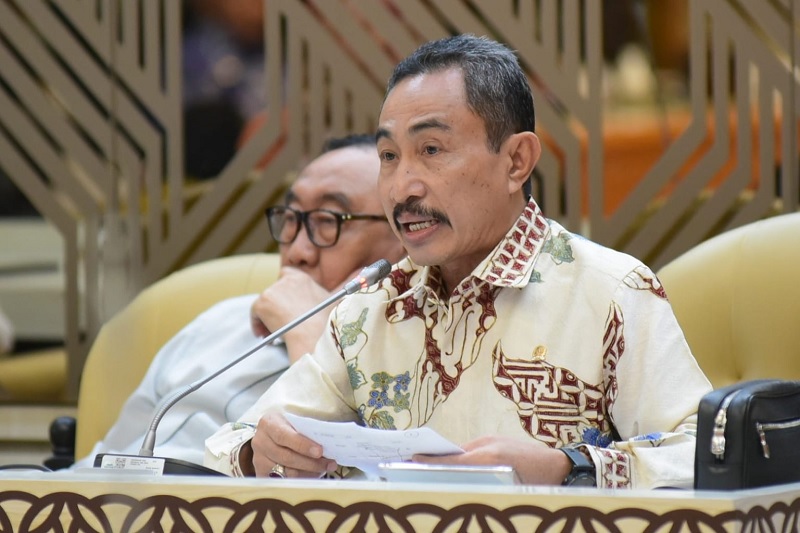
Fajarasia.id – Commission V of the Indonesian House of Representatives (DPR RI) held a working meeting with Minister of Transportation Dudy Purwagandhi to review the implementation of the 2025 state budget (APBN) and discuss the ministry’s work plan and budget for 2026. During the session, legislator Haryanto raised questions about unusual budget allocations, including spending on “immune boosters” at transportation terminals.
The meeting, held at the DPR Complex in Senayan, was chaired by Commission V members and focused on scrutinizing budget details. Haryanto, from the Indonesian Democratic Party of Struggle (PDIP), initially criticized the large allocation for office stationery (ATK), noting that many programs still list ATK expenses despite the government’s increasing reliance on digital systems.
Haryanto then highlighted significant spending labeled as “immune boosters” across multiple terminals, with allocations ranging from Rp 97 million to Rp 186 million per terminal. He questioned the distinction between these expenses and the existing budget for medicines.
“Is this meant to be some kind of stamina supplement or even a form of ‘strength enhancer’? Because below that, there is already a budget line for medicines,” Haryanto remarked, asking the minister to clarify the difference.
The lawmaker stressed that such allocations should be reviewed to ensure efficiency and proper use of funds. He argued that the money could be redirected to more pressing needs within the ministry. “We are not looking for mistakes, but exercising oversight. If the allocation is not appropriate, it should be redirected to programs that truly benefit the public,” he said.
Haryanto also raised concerns about a Rp 3.2 billion allocation for the procurement of a water bus on the Bengawan Solo River. He noted that Commission V had little prior knowledge of the project and sought clarification on its purpose.
“This is not about fault-finding, but about ensuring that budget allocations are accurate and useful for the ministry’s objectives,” he added.
The discussion underscored DPR’s role in monitoring government spending and ensuring transparency in budget planning. Legislators emphasized that efficiency and accountability are essential to guarantee that public funds are used effectively and in line with national priorities.****