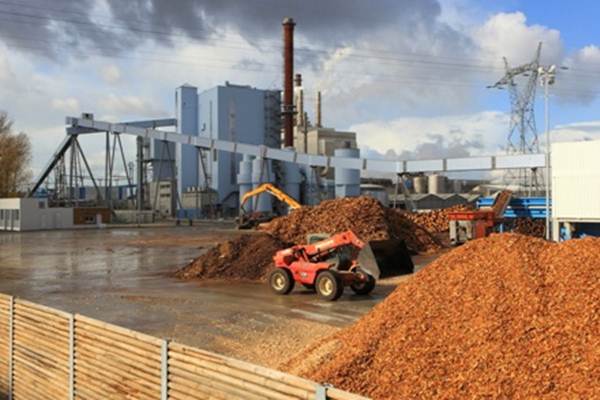
Fajarasia.co – PT PLN (Persero) through its subsidiary PT Pembangkitan Jawa Bali (PJB) has tested the use of 100 percent palm shell biomass in a Steam Power Plant (PLTU), as a raw material for coal replacement (firing).
President Director of PT PLN (Persero), Darmawan Prasodjo in Surabaya, Thursday said the use of up to 100 percent of biomass in the High Co-Firing (HCR) trial was the first in Indonesia, as well as an answer to the future of clean energy in the country.
He said the results of the trials on the PLTU with a capacity of 2×7 megawatts (MW) Tembilahan Indragiri Hilir Regency, Riau Province which were carried out had shown positive results.
PLN, he said, will continue to optimize the implementation of co-firing until it reaches a capacity of 1.8 gigawatts. And from the target of 52 locations in the implementation phase in 2025, biomass cofiring has been implemented in 31 locations, with the utilization of 175 thousand tons of biomass.
This achievement resulted in the production of 185 GWh of clean energy, with a reduction of 184 thousand tons of CO2.
“The acceleration of the biomass firing program is clear evidence of PLN’s seriousness in supporting the government in reducing carbon emissions in the country to achieve the carbon neutral target by 2060,” he said in a press release received by the editors, Friday (17/6/2022).
Director of Operations 1 PT PJB Yossy Noval explained, testing 100 percent of the biomass firing at the Tembilahan PLTU was carried out in stages according to the planned procedure.
The initial stage starts from using 25 percent of biomass as a substitute fuel on Sunday (12/6), to completion of 100 percent biomass firing on Wednesday (15/6).
“Based on the joint evaluation, the results of technical monitoring showed that the operating parameters were still within normal limits, the 7 MW load could be maintained stably, and there was no load derating up to a maximum of 100 percent biomass,” he said.
On the other hand, the data shows the potential for improving fuel flow and NPHR is quite significant because palm shells have a high calorific value.
From the environmental aspect, he said, palm kernel shells have a lower sulfur content than coal so that the resulting emissions show a decrease.
The shells used are from plantation waste, low in ash and included as carbon neutral, so that it will have an impact on a better environment.
“This success is the fruit of a series of studies conducted by PJB regarding co-firing since 2019,” he said.
Previously, the co-firing program for coal-fired power plants with biomass was one of PLN’s programs to support the national new and renewable energy mix (EBT) target.****