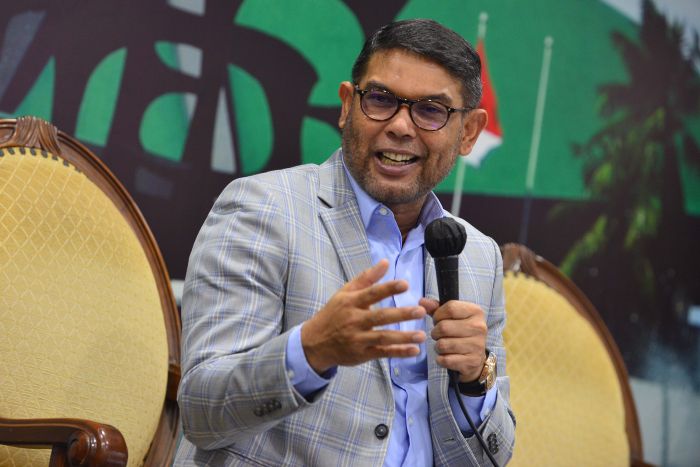
Fajarasia.id – Member of Commission III of the House of Representatives (DPR RI), Muhammad Nasir Djamil, has called on the government to promptly follow up on the Constitutional Court’s (MK) ruling that prohibits active police officers from holding civilian positions.
Nasir emphasized that, in principle, Constitutional Court decisions should be implemented immediately. However, he acknowledged that in practice, execution often takes time.
“Normatively, Constitutional Court rulings can be enforced right away. But in reality, it is rare to see such decisions executed instantly,” Nasir said on Sunday (November 16, 2025).
The ruling in question, Decision No. 114/PUU-XXIII/2025, annulled the phrase “not under assignment from the National Police Chief” in the explanation of Article 28 paragraph (3) of Law No. 2/2002 on the Indonesian National Police. This effectively closes the door for active police officers to occupy civilian posts unless they resign or retire.
Call for Legal Alignment
Nasir argued that the government and DPR must consider revising the Police Law to align with the Civil Service Law (ASN Law) and regulations on civil servant management. He also highlighted the legal principle lex posteriori derogat legi priori, meaning newer laws override older ones.
The Constitutional Court’s ruling was delivered by Chief Justice Suhartoyo during a plenary session in Jakarta on Thursday (November 13, 2025). Justice Ridwan Mansyur explained that the contested phrase created legal ambiguity, leading to uncertainty both for police officers and civil servants.
Background of the Petition
The judicial review was filed by Syamsul Jahidin and Christian Adrianus Sihite, who argued that the placement of active police officers in strategic civilian roles—such as Chair of the Corruption Eradication Commission (KPK), Head of the National Narcotics Agency (BNN), Deputy Head of the National Cyber and Encryption Agency (BSSN), and Head of the National Counterterrorism Agency (BNPT)—violated the principle of neutrality in state apparatus.
They contended that such practices undermine democracy, meritocracy, and the constitutional rights of civilian professionals to compete fairly for public office.****