Fajarasia.co – The Indonesian Traditional Fishermen Association (KNTI) wants an additional budget allocation related to the restoration of coastal ecosystems in order to overcome tidal flooding in various regions.
“Allocate a budget for mitigating and adapting to the impacts of climate change in coastal areas that is fair and in favor of environmental recovery,” said KNTI Daily Chair Dani Setiawan in a written statement received by the Editor, Friday (27/5/2022).
Dani explained, the allocations include infrastructure development for flood control, normalization of rivers and estuaries, construction of habitable houses, provision of weather information, construction of habitable houses, to the provision of insurance assistance schemes to compensate for losses suffered by fishermen or cultivators.
He reminded that the tidal flood inundated many coastal areas in Indonesia this week, so that the activities of residents on the coast were paralyzed, especially small fishermen, fish cultivators, salt farmers, fish processors and fish marketers at both the small and large basket level. B
“Based on the results of data collection from the Regional Management Board (DPD) of KNTI in Java and Sumatra, Semarang City, Demak Regency, Pekalongan Regency, Kendal Regency, Pemalang Regency, Bangkalan Regency, Tuban Regency, Bangkalan Regency, Gresik Regency, Lamongan Regency, Surabaya City, Indramayu Regency and Tangerang Regency are areas affected by tidal flooding on Java Island.
Meanwhile, the tidal flood that occurred on Sumatra Island was spread across Medan City, Tanjung Balai City, and Batubara Regency,” he explained.
According to him, there were 15,820 fishing fishermen affected by sinking settlements and extreme weather in the past week. Due to the tidal flood, many residents’ houses were submerged, including electronic goods and fisherman’s transportation, which were flooded and fishermen suffered material losses.
In addition, other losses that have the greatest impact are people’s aquaculture activities and salt farmers because of the potential for crop failure to reach billions of Rupiah. More than 3,226 fish farmers with a total land area of 31,900 hectares were affected by the tidal flood.
“Flood heights that reach 50 to 100 centimeters have hampered the mobility of residents and pre-production economic activities until after production is affected by the closure of the Fish Auction Place,” he said.
Regarding the budget, he revealed that the Ministry of Maritime Affairs and Fisheries’ budget work plan (RKA) document in 2020, the budget allocation for climate change mitigation and adaptation is only 0.31 percent of the total KKP budget of Rp. 6.4 trillion.
At the regional level, he continued, the results of the KNTI study in Central Java Province for example, climate change adaptation and mitigation programs for coastal communities and fishermen have not become a priority, which is shown, among other things, by the proportion of climate change budget allocations in coastal areas in 2019 reaching 31.81 percent. of total climate change spending or only 0.20 percent of total regional spending.
In 2021, the proportion of climate change budgets for coastal areas will only receive an allocation of 8.52 percent of total climate change spending or only about 0.08 percent of total regional spending.
To that end, he encourages an effective coordination approach between local governments within one province. Tidal flood events that hit many coastal areas, especially in Java, North Sumatra, and are increasingly spreading to other areas, require collaborative steps from each region to maximize mitigation and adaptation efforts.
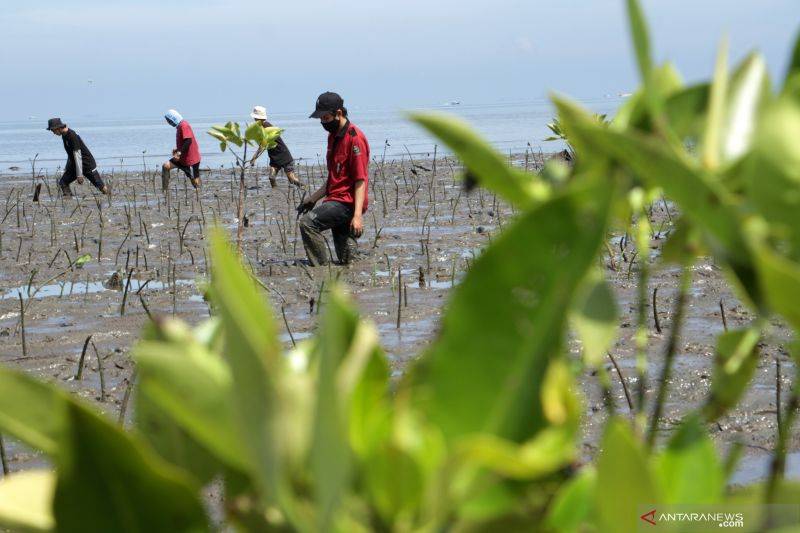
“Take a holistic approach to rehabilitate and protect mangroves as a coastal belt whose sustainability is guaranteed from development activities and seizure of marine space,” he said.
He also encouraged the importance of making comprehensive mitigation and adaptation programs by involving the full participation of fishermen, cultivators, salt farmers, fish processors, fisherwomen, and youth, as well as transitioning extractive activities on the coast by carrying out environmental restoration as a full commitment to mitigation and adaptation to climate change impacts.****