Fajarasia.co – Parliamentary threshold (PT) is a parliamentary threshold that has been in effect since the 2009 election with a figure of 2.5%, then continues to increase in line with the revision of the Election Law, until the last PT provision rose to 4%. And to this day, the PT provisions continue to be the pros and cons between large and small political parties.
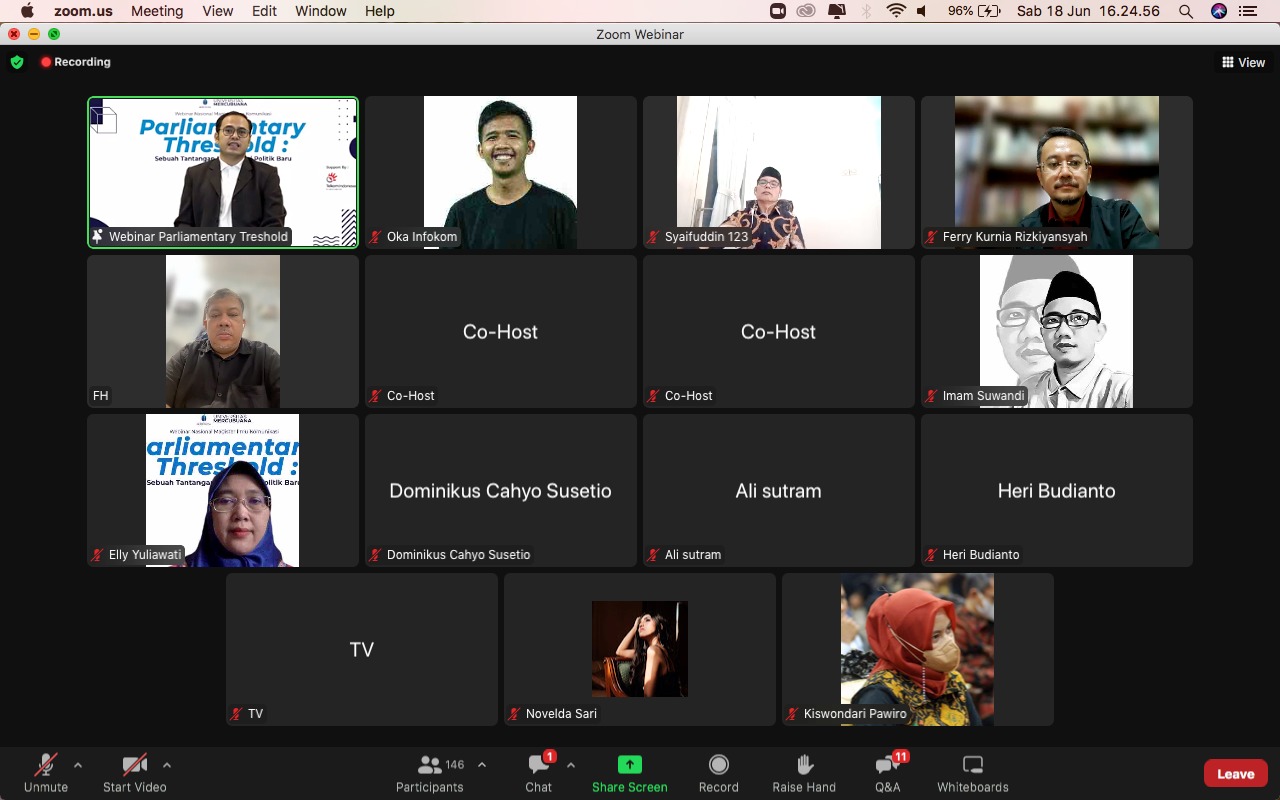
A number of views, criticisms and suggestions related to the PT’s provisions were conveyed by a number of competent sources in the national webinar for Political Communication class, Masters in Communication at Mercu Buana University (Mikom UMB) entitled “Parliamentary Threshold: A Challenge for the New Party”, through a press release received Editor, Sunday (19/6/2022).
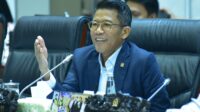
Regarding this provision, Member of Commission II of the DPR RI Rifqinizami Karsayudha said that 9 factions in the DPR RI had agreed that there would be no revision of Law no. 7 of 2017 concerning Elections (Election Law) for the DPR for this period. So, the norms that apply in the 2024 Election are the ones that apply like the 2019 Election, because there are no new norms and changes.
“Well, therefore, I am sure that the provisions related to the 4% parliamentary threshold will continue to be used as a basis for political parties to contest in the legislative elections, especially the election for members of the DPR RI in 2024 which will come,” said the PDI-P politician in his presentation.
The man who is familiarly called Rifqi also emphasized that this PT stipulation only applies at the national level, although there was a discourse on establishing PT in stages for the provincial and district/city DPRD.
Then, said Rifqi, in the theory of institutionalization or the institutionalization of political parties. One indicator of the institutionalization of a political party is the extent to which the political party has solid roots, or a solid constituent base. And it must be wrapped in an ideology of each political party to be tested in the election. And the roots of the political parties must be strengthened, either naturally or through a regulation, namely the presence of 4% PT.
“The more institutionalized a political party is, the healthier it is. The figure of 4% is a moderate number in our view, so that it allows new parties to continue to exist in the DPR RI or parliament at the national level,” he explained.
According to this South Kalimantan I electoral district legislator, a number of new parties that have not been able to enter the PT in the 2019 election are political facts that cannot be ignored, as are the two parties that previously existed in the DPR, in this case PBB and Hanura. However, there are also successful political parties, namely the Nasdem Party and the Gerindra Party.
“There is no guarantee for parties that already exist in the DPR, if they do not take care of their constituent base, work for the people, fight for the aspirations of the people, their parliamentary work is not appreciated, including the work of their representatives in the executive, including their structures at the lower levels. . This PT is an early warning to continue to ensure our grassroots strength works well,” he concluded.
Meanwhile, UMB Mikom Communications and Public Policy Lecturer Syaifuddin conveyed that it must be understood that this PT is one of the important components in an electoral system. And to find a solution to this tangled PT, the discussion can’t just stop at the PT issue, because it will never be completed, because PT does not stand alone in the electoral law system.
“PT is interrelated with other components in our electoral system, but there is interdependence, interdependence between one component and another, electoral threshold, presidential threshold, proportional system, multi-party system, presidential system and so on,” he said in a statement. equal opportunity.
“The components that exist in the election as a system must be disclosed in the main components related to this electoral system, especially the parliamentary threshold,” he continued.
The man who is familiarly called Dr. Budi saw that the debate over the PT 4% discussion had often occurred in Commission II of the DPR RI but failed, because each faction had its own interests.
For political parties that are against PT 4%, Budi explained, the bigger the PT is raised, the more people’s votes are wasted, even Ferry Kurnia said that there were 13.5 million more political party votes wasted in the 2019 Election and 9 political parties did not pass the PT in The 2019 election. Then, the implementation of this PT violates democracy because the loss of votes is so large, the PT also reduces the proportionality value of seat allocation in Senayan.
“It is impossible for political parties in Senayan to reduce PT from 4% to 0%. Those who want to increase PT are considered by new political parties, including Gelora, as a trick by big political parties,” he said.
Budi continued, while the meaning of implementing PT for its regulators is a product of political repetition, logic rather than political game theory. According to him, the PT discussion is a silent negotiation room which is seen as a ruse between the major political parties in parliament. This is a matter of role play in the process of calculating interests and attracting the interests of political parties and PT. This is a forgotten public affair.
“The implementation of this PT is a blind and deaf political act because it does not pay attention to the condition of a pluralistic society, conditions in the region. This PT problem which tends to be raised will further increase the disproportionality of the election later, while changes to the revision of the election law are no longer possible, this is a problem,” he explained.
Therefore, Doctor Budi wants to provide two solutions for the party system and elections. As is well known, in this world there are 3 prevailing party systems, namely: the single party system. second, the two-party system. third, the multiparty system. Then the first solution option is to apply a three-party participatory model or three-party participation model. In contrast to the New Order (Orba) era, this model became a way out to strengthen consensus and reduce the pros and cons of PT.
“Three parties will be able to accommodate effectively and efficiently all interests that have been rooted in the history of Indonesian society, there are nationalists, religious and socialists or it could be communists,” he explained.
“If we start from the history and multiculturalism of the Indonesian nation, the three groups were founded. This three-party model may be relevant,” he continued.
The second idea, he added, is deliberative static multiparty or deliberative static party model. The spirit is that in the decision-making system, decisions are taken and inspired by the combination of the guided democracy system and Jurgen Habermas’ deliberative democracy as the 4th precept, whose spirit is deliberation to reach consensus.
“The party that achieves the PT is leading the faction, and the party that does not reach the PT is the representative in the faction. So the factions with the political means together for deliberation reach consensus, between large and small political parties, so that the votes obtained are not wasted like the 13.5 million earlier. The merger of the votes of political parties that do not reach to political parties that reach PT, there is no party fusion, the direction is the merging of political parties’ votes, “explained Doctor Budi.
Meanwhile, Deputy Chairperson of the Indonesian Unity Party (Perindo) DPP, Ferry Kurnia Rizkiansyah, said that his party was very optimistic about breaking the 4% figure in the upcoming 2024 Legislative Election (Pileg).
“That we will reach 4 percent of the vote yes and it could even be more,” said Ferry.
According to the former commissioner of the Indonesian KPU, a number of preparations have also been made by the Perindo Party. This includes strengthening the party’s organizational structure as initial capital, as well as strengthening the external party.
In fact, said Ferry, Perindo has made various kinds of ideas, one of which is the Perindo People’s Convention as a means of recruiting the best legislative candidates and initiating the Non-parliamentary Coalition.
“This People’s Convention has been carried out. This will change the grand narrative and change the democratic process to be more proactive. We also initiated the Non-parliamentary Coalition, that is what we are doing,” he said.
On the same occasion, Deputy Chairperson of the Gelora Party Fahri Hamzah alluded to the dirty ways that are often encountered during elections in Indonesia, namely ‘dawn attacks’, props war, distribution of social assistance (bansos), not competing ideas to bring about change for the better for the nation.
“Every election, which should be a momentum to bring up new national ideas, allows our leader to show that he is capable of dealing with the nation’s problems,” said Fahri on the same occasion.
Fahri suggested that the government should bear 100% of the election costs, including funds for political parties (Parpol). The reason is that political parties and their candidates must be facilitated by the state, otherwise it will cause people who have a lot of money to sneak up on political parties.
“If the political costs are borne by each individual, later political figures will feel they have to return the capital they spent for certain positions. Moreover, the cost of politics in Indonesia is not cheap,” he said.
The former deputy chairman of the DPR RI also highlighted the 2024 election budget that had been agreed by the government, the DPR RI and the election organizers namely the KPU, Bawaslu and DKPP at Rp 76.6 trillion. This figure was obtained after several revisions from the original Rp 86 trillion.
This politician from West Nusa Tenggara (NTB) is also worried that political figures already consider the funds spent during the campaign as a personal expense, so what happens next is that they will now have to pay back their investment.
“Or bohir-bohir (financiers) who pay him and then want the capital to be returned,” he explained.
According to him, the impact of such a political phenomenon has the potential to create regulations that are not in favor of the community and this can be seen, subtly or grossly, these days. This phenomenon is also a threat to Indonesian democracy, because the potential for transactions in politics increases
In fact, Fahri added, any attempt to monetize this battle of ideas is dangerous, so the government must be serious about discussing how to finance the elections.
“I think this is a vicious circle that we must break through realizing again that democracy is a battle of ideas,” he said.
The webinar was also attended by the Dean of the Faculty of Communication at Mercu Buana University, Dr. Elly Yuliawati, M.Si and the Head of the Master of Communication Studies Program, Mr. Dr. Heri Budianto, M.Si who also gave a speech. The event which lasted for 2.5 hours was also attended by 295 virtual participants.****