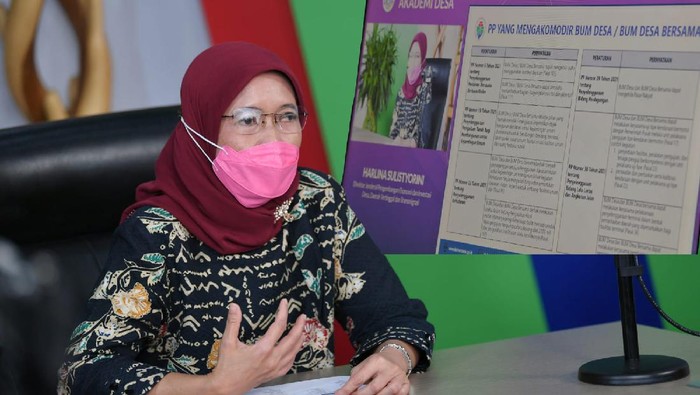
Fajarasia.co – Director General of Economic Development and Investment in Villages, Disadvantaged Regions and Transmigration of the Ministry of Villages PDTT Harlina Sulistyorini said, as many as 3,498 women in Indonesia have become village leaders and are trying to build inclusive villages.
“From the regulations in the village law, it has been stated that the village head is obliged to carry out a democratic life that is gender-just. Then it is also regulated that the Village Consultative Body (BPD) pays attention to the area of women, residents and village financial capabilities,” said Harlina in a release received by the Editor, Thursday (9/6/2022).
Harlina said the women who served as village heads had spread across eight provinces of Indonesia. With details on Java (1,527), Sulawesi (736), Sumatra (648), Kalimantan (211), Papua (188), Bali and Nusa Tenggara (103) and Maluku (85).
However, the number of female village heads in Indonesia can still be said to be low because it is less than five percent. Even though there are at least 74,962 villages spread throughout Indonesia.
Thus, the participation of every woman must continue to be increased so that programs in the village can be more systematic, partial and friendly to women, persons with disabilities and children.
According to Harlina, the voices of women who are involved in every village meeting can provide a clear picture of the needs for the lives of children in the village. For example, village funds are used to establish PAUD, posyandu services or additional community nutrition as an effort to prevent stunting in children (stunting).
“So with the involvement of women starting from village meetings, we hope that it will also reduce gender inequality in the village. In this way, village development will look more friendly to women and children. We also collaborate with KPPPA regarding strengthening gender awareness in villages. So that we have a village that is friendly to women and children,” he said.
Harlina further admitted that her party had not been able to confirm the number of inclusive villages in Indonesia at this time. However, he hopes that all villages can become inclusive and highly empowered.
Therefore, Harlina invites every party, government, private and community to work together to encourage women’s participation at the village level. Thus, every decision taken can advance village programs and performance to remote areas and eastern Indonesia.
“No one left behind can be one of our taglines, so that all people in rural areas can enjoy development, starting from women, people with disabilities and so on,” he said.****