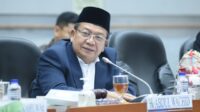
Fajarasia.id – Coordinating Economy Minister Airlangga Hartarto said Indonesia’s unemployment and poverty rates were falling and the government was optimistic that economic growth could reach 5.3 per cent this year.
“Indonesia’s economy is estimated to grow by more than 5% by 2022, reaching 5.3% year-on-year. Economic fundamentals remain strong. Consumption, investment and exports are driving the national economy.” Coordinating Minister Airlangga, who is also the general chairman of the Golkar Party, said on Thursday (26 January).
Economic recovery from the impact of Covid-19 continued, fiscal consolidation exceeded estimated targets, and the government budget deficit (APBN) returned to below his 3% of Gross Domestic Product (GDP), or his 2.38% of GDP. I’m here. Airlangga Hartarto also said the unemployment rate will drop to 5.8% in August 2022 and the poverty alleviation rate will drop to 9.54% in March 2022.
CELIOS Executive Director Bhima Yudhistira said he expects Indonesia’s economic growth to fall slightly below the government’s forecast this year due to the achievement. “Economic forecasts for this year could still grow by more than 4.7%,” Bhima said on Thursday.
A weakening factor is the slowdown in exports due to the potential impact of the global recession. Commodity prices have also started to stabilize, and public consumption is increasing. However, he is optimistic that social restrictions will be lifted once people start moving.
“Workers who have been laid off or laid off previously will be put back to work once the economy is up and running again. If there are more job opportunities, we can reduce the poverty rate,” Bhima said.
Indonesia’s domestic economy is ‘blessings in disguise’ despite people’s declining purchasing power. “In the midst of the pressures of a global recession, Indonesia has hidden treasures. First, the domestic market is large, especially given the working age population of 190 million. Second, SMEs contribute significantly to employment. And only 18% of export-oriented SMEs are immune to a slowdown in economic activity in destination countries,” said Bhima.
For this reason, Bhima suggested that in early 2023, stimulus measures from the government, such as levels, would be needed to tighten the national economy more.
continue welfare
On the other hand, a public policy observer at Trisakti University Turbas Lahadianthia assessed that poverty reduction was due to government welfare (welfare) support to the community rather than job creation.
“I believe the decline is due to social assistance. Employment is increasing in the agriculture and plantation sectors, if employment is counterproductive due to weak job creation so far,” he said.
According to him, factory workers returned to their villages during the pandemic to work in agriculture, plantations and his MSME sector. For this reason, Mr. Trubus suggested that the government prioritize this sector in order to anticipate the threat of a global crisis. “In the future, the government must encourage the agriculture and plantation sector to become a foundation and priority for development and economic growth,” he said.
Mr Trubus added that while welfare remains the mainstay, job creation is also very urgent. Governments need to recognize sectors safe from the global crisis and potential, such as plantations, agriculture, MSMEs, cooperatives and technology. “But for manufacturing, I think it’s a little bit difficult,” he added.
Trubus believes welfare will be used to boost the grassroots economy so that domestic consumption can be sustained. But governments are also called upon to improve the governance, evaluation and monitoring of social assistance distribution.
“Social assistance continues, why? Because welfare is the ‘base’ of grassroots communities and drives the grassroots economy,” he concluded.****