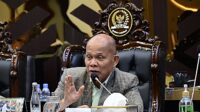
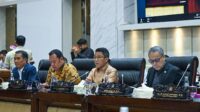
Fajarasia.id – Member of Commission IV of the House of Representatives (DPR RI), Firman Soebagyo, has proposed the establishment of a dedicated Food Ministry as a strategic step to strengthen Indonesia’s food security and sovereignty. The proposal was delivered during a Public Hearing (RDPU) on the Draft Food Bill (RUU Pangan) with the Indonesian Farmers Union (SPI) and Jaringan Petani Persada at the Parliament Complex, Senayan, on Monday, November 17, 2025.
Firman argued that one of the root problems in Indonesia’s food governance is the absence of a single institution overseeing policy in a comprehensive manner. At present, food-related affairs are spread across multiple ministries—including agriculture, trade, state-owned enterprises, and social affairs—leading to fragmented and overlapping regulations.
“We need a single umbrella for food policy. That’s why I propose the establishment of a Food Ministry that focuses on regulation from upstream to downstream,” said the legislator from Central Java III.
He explained that the ministry would serve as the regulator, while operational execution of food distribution should remain under Perum Bulog. In this model, Bulog would act as the sole executor in managing food reserves, stabilizing prices, and absorbing farmers’ harvests.
“Bulog must return to its role as the main executor. The ministry sets the regulations, Bulog implements them. No need for new councils or agencies—this consolidation will cut bureaucratic layers,” he emphasized.
The Golkar Party politician added that national food stability cannot be achieved if institutional structures remain fragmented. He stressed that a centralized Food Ministry would simplify oversight, accelerate decision-making, and improve coordination among agencies.
Firman also recalled that Indonesia once enjoyed strong food stability when governance was centralized. However, this changed after the reform era, when state authority was weakened by fragmented regulations.
“If the nation wants self-sufficiency and stable prices, governance must be strong. Food policy cannot be divided among multiple ministries with different directions,” he said.
He further noted that the ongoing Draft Food Bill could serve as an entry point to design a more efficient and integrated food governance structure.
“The Food Bill must address the root problems. Otherwise, we’re only amending articles without fixing the system. What we need is an institutional breakthrough,” Firman concluded.****