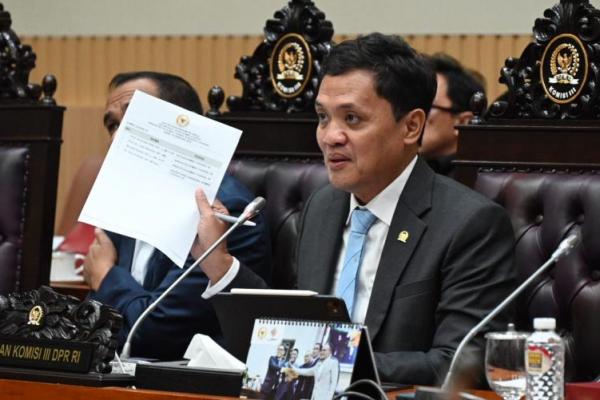
Fajarasia.id – Chairman of Commission III of the House of Representatives (DPR RI), Habiburokhman, emphasized that the drafting of Indonesia’s new Criminal Procedure Code (KUHAP) is not a unilateral initiative by the government or parliament. Instead, he stated that nearly all of its substance—99 percent—originates from public aspirations.
According to Habiburokhman, the provisions in the revised KUHAP reflect recommendations from academics, legal aid institutions, and civil society organizations that have long advocated for criminal justice reform.
“It is completely wrong to say this KUHAP suddenly appeared without listening to the people. Almost all of its content comes from public input. We adopted suggestions from universities, NGOs, and legal practitioners,” he said during a press conference at the Commission III meeting room, Nusantara II, Senayan, Jakarta.
He explained that Commission III carried out an extensive and transparent deliberation process, engaging with groups such as the Institute for Criminal Justice Reform (ICJR), The Indonesian Judicial Monitoring Society (MaPPI FHUI), Legal Aid Foundation (LBH), and law faculties across the country. Each article, he noted, underwent public testing, dialogue, and technical discussions before being finalized.
Habiburokhman also corrected misinformation circulating on social media, particularly claims that the new KUHAP expands law enforcement powers in arrests, searches, and seizures.
“The truth is the opposite. The new KUHAP tightens all procedures. Searches and seizures now require judicial approval and can no longer be carried out arbitrarily. These provisions came directly from public demands during consultations,” he stressed.
The revised KUHAP also enhances protections for suspects, including mandatory notification to families, clearer standards for preliminary evidence, and stricter requirements for detention. These reforms, he said, respond to long-standing concerns from civil society about abuse of authority.
Habiburokhman reiterated that Commission III’s work is rooted in public aspirations, not institutional interests. He urged the public to evaluate the KUHAP based on the official text rather than provocative social media posts.
“We welcome criticism, but it must be based on the law itself. This KUHAP is born from the people’s voice—99 percent of it reflects their aspirations,” he said.
He expressed hope that the new KUHAP will serve as a strong foundation for criminal justice reform, safeguard citizens’ rights, and close loopholes for abuse of power. “This KUHAP does not belong to the government or parliament. It belongs to society. It is a collective work to realize justice,” he concluded.****