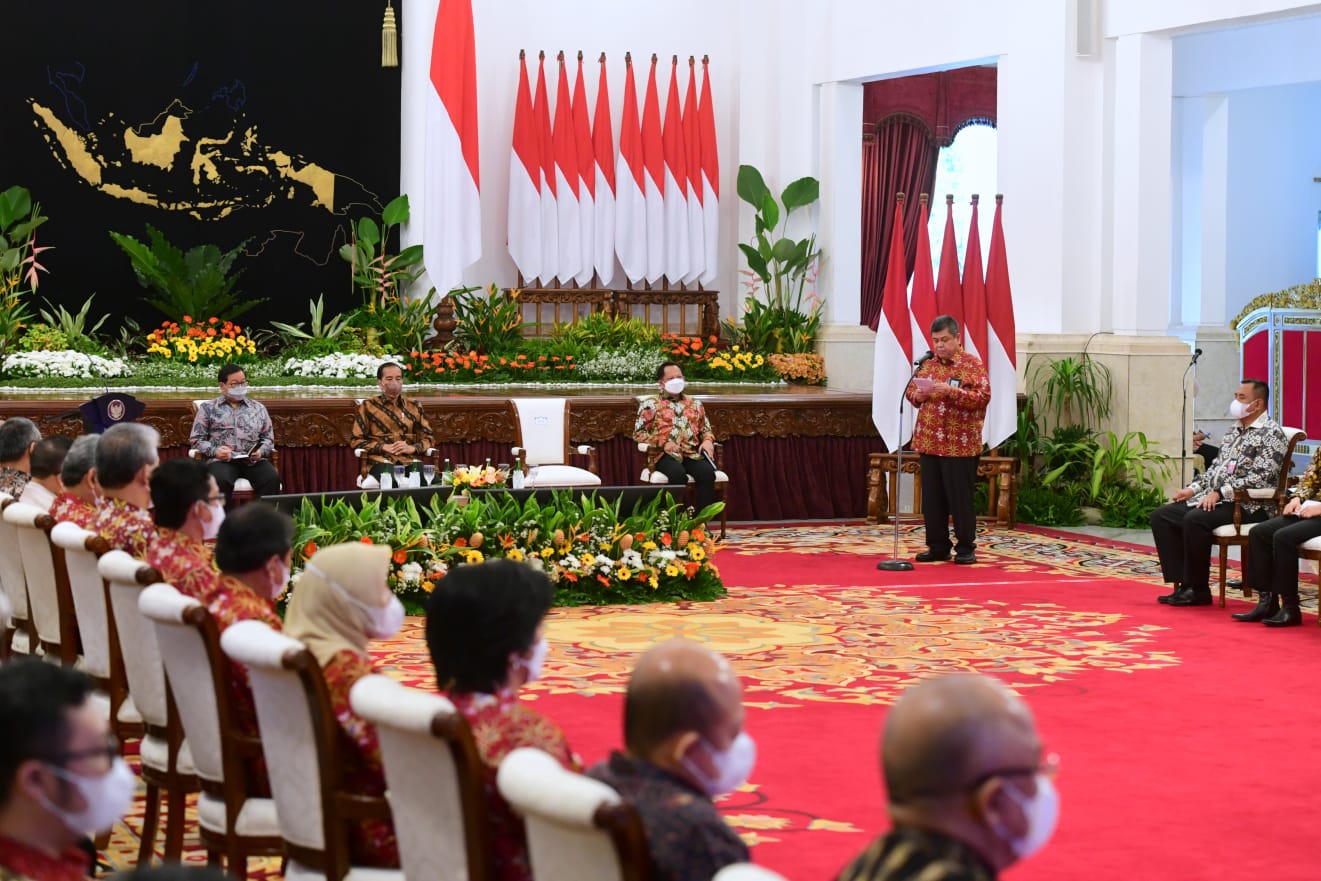
Fajarasia.co – Head of the Financial and Development Supervisory Agency (BPKP) Muhammad Yusuf Ateh said that there was an increase in the commitment to spending on domestic products (PDN) by ministries, institutions, local governments (KLD), and SOEs.
As of Monday (13/6/) yesterday, he revealed, there was an increase in the commitment to PDN spending to Rp722.88 trillion.
“Alhamdulillah, Mr. President, until yesterday, June 13, 2022, the PDN that was published in the e-catalog and its transactions for the first time had succeeded in competing with imported products.
Our most validated results also show that as of June 13 yesterday, KLD and SOEs have committed to absorb local products worth IDR 720.88 trillion,” Yusuf said in his report to President Joko Widodo (Jokowi) during the opening of the 2022 National Coordination Meeting for Government Internal Control at the State Palace, Jakarta, Tuesday (14/6/2022).
“This is the actual validation result, sir. Meanwhile, the realization of PDN spending has reached 180.72 trillion, this is the result of the inspection, sir, or 45.14 percent of the 400 trillion target,” he said.
According to him, the target is in accordance with the mandate of the Indonesian Presidential Instruction No. 2 of 2022 concerning the Acceleration of Increasing Domestic Products and Products of Micro, Small Business, and Cooperatives in the context of the success of the Proud National Movement Made in Indonesia in the Implementation of Government Procurement of Goods/Services.
In the Presidential Instruction, the President instructed that at least 40 percent of the budget for goods/services should be used to absorb MSME products and cooperatives produced by PDN.
In addition, Yusuf also identified a number of major problems with the commitment to spending on domestic products (PDN), which must be resolved.
“At the planning stage, KLD has difficulty identifying expenditures that can be optimized to absorb domestic products. The absence of a principled reference list regarding PDN with good TKDN is one of the causes of the difficulty in planning local product purchases,” he said.
At the implementation stage, he continued, there were still imported products purchased by the government even though there were already substitutes for local products.
“Based on BPKP’s supervision, there are at least 842 imported products purchased through e-catalogs that already have local products. One of the reasons for this reluctance to absorb this is because the prices of local products are relatively higher than imported products,” he continued.
From the BPKP test sample, there were 853 imported products purchased. A total of 560 products or about 66 percent are cheaper than local products.
“Meanwhile, for import spending due to the absence of substitute local products, it is necessary to immediately encourage the development of related local industries,” he said.****