Fajarasia.co – Indonesia is currently in the process of preparing for the implementation of the Carbon Economic Value (NEK) instrument which puts a price on carbon emissions resulting from various production and service activities, as well as commitments related to energy subsidy reform.
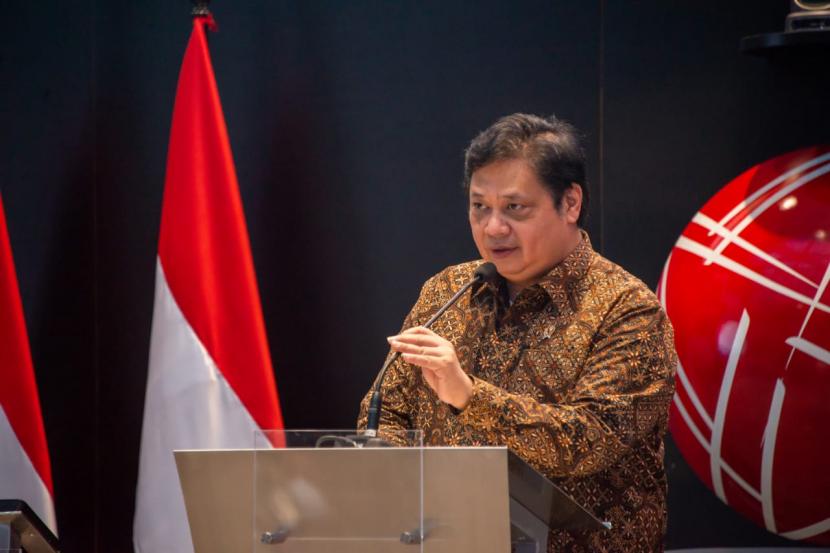
“The implementation of the NEK instrument is expected to encourage industries to be more environmentally aware and limit greenhouse gas emissions to a certain extent,” said Coordinating Minister for the Economy Airlangga Hartarto in a webinar release themed “Increasing Fiscal Space in Times of Economic Uncertainty: The G20 Energy Communique. and Leaders Declaration” received in Jakarta, Thursday (9/6/2022).
Airlangga added, on the other hand, the NEK instrument acts as an alternative funding instrument to achieve Indonesia’s climate change targets, both the Nationally Determined Contribution or NDC 2030 and Net Zero 2060.
To support the implementation of the NEK, he said, the government implemented Law no. 7 of 2021 concerning Harmonization of Tax Regulations and Presidential Regulation No. 98 year 2021.
It is stated that this Presidential Regulation is the basis for implementing various NEK instruments such as the Emission Trading System or emissions trading, Offset crediting or carbon credits, and Result Based Payments. Meanwhile, at the technical level, the government is finalizing the derivative regulations of the Presidential Regulation.
“In 2021, the government will pioneer a voluntary cap and trade scheme, and offset crediting, which involves several electricity producers, both state-owned and private. In parallel, the government is collaborating with several international institutions in conducting assessments and studies on the development of carbon trading policies and schemes through Internationally Traded Mitigation Outcomes (ITMOs),” he said.
In the future, namely in July 2022, Indonesia plans to implement a cap-trade-tax and offset scheme for coal-fired power plants. Under this scheme, coal-fired power plants with inefficient processes or emissions higher than the upper limit will incur additional costs.
Meanwhile, Head of the Planning Bureau of the Ministry of Energy and Mineral Resources, Chrisnawan Anditya, said the government has committed to reforming energy subsidies so that they are right on target.
“We must pay attention to the community so that they can access energy at affordable prices. That is a concern in transitional energy,” said Chrisnawan in the webinar.
According to Chrisnawan, subsidy reforms have been carried out, including in the electricity sector. It is hoped that this subsidy policy will be more focused from commodities to direct subsidies to the community. “This is done by taking into account the availability of the state budget for the energy transition,” he said.
As announced, the Presidential Staff Office (KSP) stated that the change in the energy subsidy scheme would be adjusted to the current economic conditions, as well as the readiness of the Integrated Social Welfare Data (DTKS).
KSP Main Expert, Edy Priyono, in his statement in Jakarta, Wednesday (25/5), said the government is considering transforming the subsidy scheme from subsidies to goods or open, to subsidies for people or a closed system.
“In order to be more targeted, only those who are poor or vulnerable to poverty will enjoy it,” said Edy.
According to Edy, with the current open subsidy scheme, there are concerns that the volume of subsidies will be unlimited. This is because people who should not be included in the category of recipients of subsidies, actually enjoy the subsidies.
In the transformation of the energy subsidy scheme, said Edy, the government will encompass people who are entitled to receive subsidies so that fluctuations in energy commodity prices do not interfere with people’s purchasing power.****